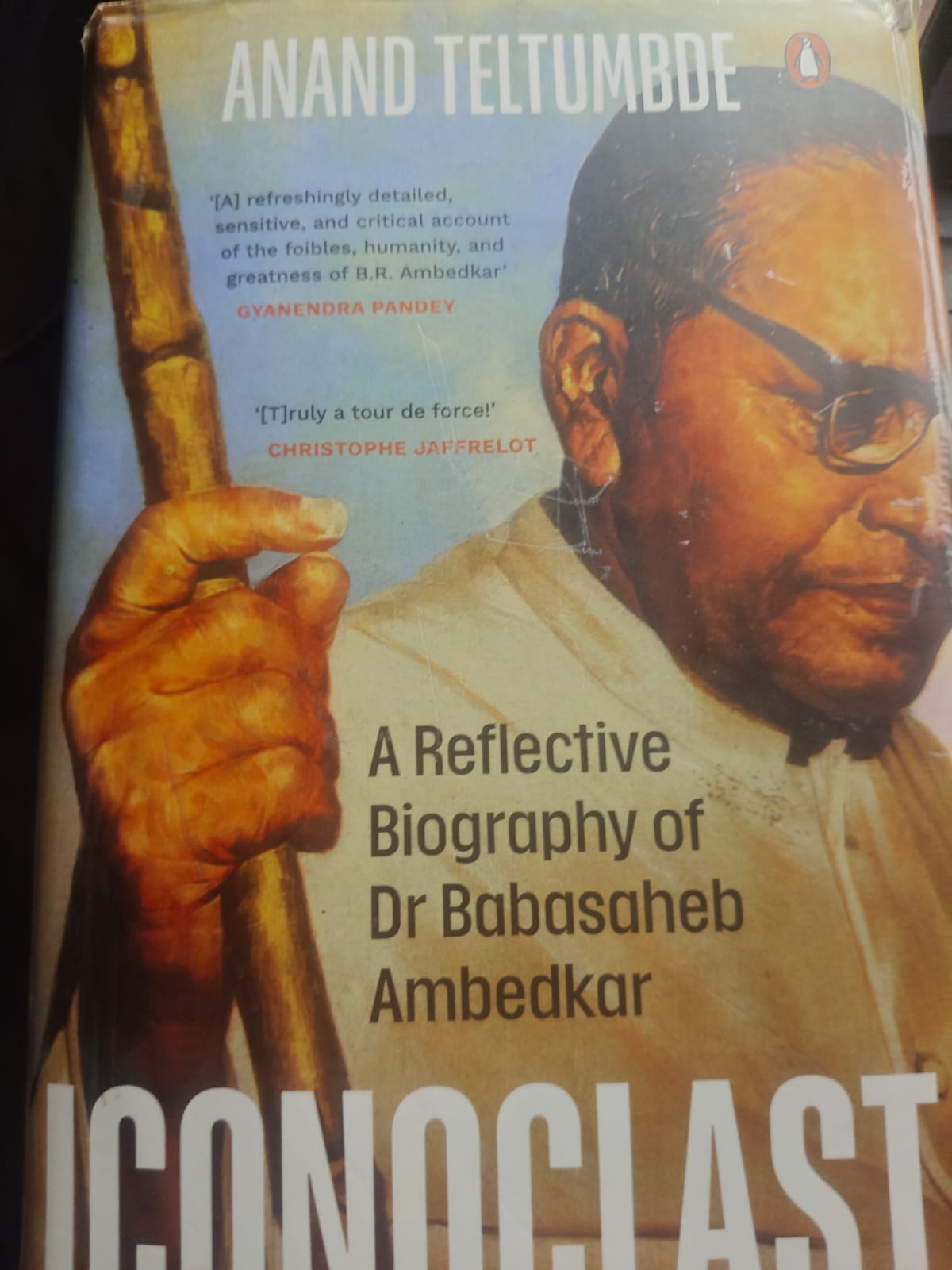
“Iconoclast: a breaker of idols”: Why Ambedkar espoused social, economic, and political freedom
We all know Dr B R Ambedkar–the architect of the Indian Constitution–and his contributions to uplift the members of scheduled communities. Born in 1891 to a Subedar Major in present-day Madhya Pradesh, he went on to become India's first Minister for Law and Justice. People often seek refuge in his life story and writings, especially those from repressed communities. He has been at the centre of debate, particularly during rights infringement, especially in the last 12 years–so much so that the opposition and the incumbent fought the entire 2024 Lok Sabha elections on his name and the Constitution.
What only a few people know is that Ambedkar was also de facto Labour Minister under British India between 1942 and 1946, where he laid the foundations of various labour legislations. Though he strove hard to uplift the “depressed class”, he did not particularly support class struggle, although he said “a caste is an enclosed class”.
So who was Ambedkar? Who were his mentors who made an impression on him? Why did he always have certain contradictions with Communist ideology? Why did he always take on Gandhi? If there is one book which describes him and his work in minute details, Iconoclast, a reflective biography of Dr Babasaheb Ambedkar by Anand Teltumbde comes as an authoritative book.
Teltumbde, an academic, author and human rights activist was arrested on April 14, 2020, in the Bhima Koregaon case and was charged under Unlawful Activities (Prevention) Act. He was released in 2022. His notable books include Republic of Caste, Mahad–the making of the first Dalit revolt, the Radical in Ambedkar, the Cell and the Soul: A prison memoir among others. In the first book review for Reporters Desk, I am delving into some of the aspects not widely known in the public, and it may not be a review in a traditional sense.
In Iconoclast Teltumbde writes that he wanted to stay away from various accounts of Ambedkar which stood as “hagiography”. In the book he delves into the complexity of caste–that social stratification always existed in many societies, however, India’s caste system has peculiar characteristics like “untouchability”.
The writer emphasises that caste and varna systems are used interchangeably; in essence, they are different. Varnas: Brahmin, Kshatriyas, Vaishyas, and Shudras and the fifth Varna who were the “untouchables”--the one who did not have any rights.
While there have been multiple changes to the caste systems, the Varna system remained unchanged. The author then says this is one of the reasons why “caste refuses to succumb before the lethal onslaughts of modernity and capitalism”.
There are stories of how Ambedkar faced discrimination while he was growing up–during his school days and later when he was a member of several committees doing his work. Interestingly, he was initially called Bhiva Ambavedkar, and a brahmin teacher gave his own surname ‘Ambedkar’ to him. In 1913 after getting a loan, BR Ambedkar set off to study at Columbia University in the US, and then in the London School of Economics.
Ambedkar thus prefers the Buddha’s method to change the mind of the man: to alter the disposition : so that whatever a person does, he does it voluntarily without the use of force or compulsion.
Dewey, Shotwell, Seligman: Pragmatism, Economist, and Reformer
This is where Iconoclast gives a detailed account on his academic journey, where Ambedkar devoured books which he bought from the streets and had 2000 volumes as his own private library. During his course of study he tried to find a “scholarly informed understanding of caste”. The book details the influence of his mentors including professors–all later established themselves as public intellectuals and it reflected on Ambedkar’s work–like John Dewey, James Shotwell, James Harvey Robinson and Edwin Seligman.
He shared Robinson’s writing that “history should seek to account for the origins of social problems” by constructing the history of shudras and “untouchables” and his general approach toward history. All his mentors’ ideology stood somewhere between freemarket capitalism and socialism. For example, Robinson did not believe that free markets would solve capitalism’s ill effects, however, at the same time was sceptical of socialism as the idea “of a dogmatic socialist with an unhistorical assumption of class struggle”. Historian James Shotwell had an underlying argument in his PHD thesis that the “nature, purpose, scope of the influence of religion has not been static across time and space”.
American public finance economist Edwin RA Seligman helped Ambedkar “develop public thinking”. He would later publish ‘Castes in India’, and ‘The problem of the Rupee: Its origins and the solutions’, ‘The Problem with India’s Defence’ among other papers.
The book explains that he was typically influenced by John Dewey who was considered to be a foremost American public intellectual–also one of the leading figures of American Fabianism. Dewey emphasised that the primary task of philosophy was not to ponder on abstract ideas or time and space among others, but to deal with basic problems faced by humanity. In Dewey’s lecture, he heard for the first time ‘liberty, equality, fraternity’--raised during the French Revolution–which later influenced Ambedkar’s work towards social reform. Ambedkar wrote: “liberty alone is not enough unless it helps create a certain sort of community that respects the value of equality”.
Iconoclast goes on to quote another book by Scott Stroud–The Evolution of Pragmatism in India: Ambedkar, Dewey, and the Rhetoric of Reconstruction–Ambedkar prided himself by calling himself “iconoclast, a breaker of idols”, and added that at the same time he favoured change through an assessment of available resources, in the name of “Dewey’s reconstruction to (instead of) violent destruction”.
On socio economic ideas of “change”, author Teltumbde wrote: “...Both were impressed by what had been achieved in the Soviet Union but became firmly opposed to Marxism for the methods adopted by communists. Dewey had opined that the scientific view of history communists propounded was thoroughly unscientific, as it assumed that a generalisation made at a particular time and place, by one Marx, was in the nature of ‘ultimate truth’ and holding good at all times and place…Like Dewey, Ambedkar preferred an experimental approach to solving problems of society over Marxists dogmatism”.
Before coming back to India, Ambedkar had a brief meeting with Lala Lajpat Rai in the US in the Columbia library, where Rai persuaded him to participate in the Indian freedom movement, however, Ambedkar declined. He felt that the movement for political independence did not address the “pervasive slavery of the lower castes by upper castes”. On this account, writer Teltumbde says that the caste argument “appears to be a constructed story by Khairmode (the first biographer of Ambedkar)”. The writer added that Ambedkar had high regard for Rai, as appeared from an Bahishkrut Bharat obituary.
Sex education, rights of the citizens–and “Educate, Agitate, Organise”
The writer then takes us to the caste struggles that Ambedkar and people like him were undergoing during 1916 onwards. In one of the conferences, Bal Gangadhar Tilak said: “If a God were to tolerate untouchability, I would not recognise him as God at all.”
Ambedkar started Marathi fortnightly newspaper Mooknayak in 1920s, and he said that there is no instrument like a newspaper for suggesting remedies for the atrocities that are happening and shall be happening on our excluded people and for discussing their future progress and means to achieve it. In the first issue of Mooknayak Ambedkar wrote that “India was the museum of inequality”.
The book quotes Mooknayak where Ambedkar wrote: “The feeling of inequality among castes, is not based on merit or demerit of individuals. The man born in a high caste, however unmeritorious he may be, is always regarded as high whereas the man born in a low caste, however unmeritorious he may be, must always remain low.” He added that the plight of untouchables has been devastating, they being ‘sunk deep into the confluence of feebleness, poverty and ignorance’.
“Is the debt of bahiskrut bharat not a public debt”: Ambedkar ran into debt while publishing a fortnightly newspaper Bhiskrut Bharat. He did not have the capacity to pay a penny to him nor was it able to afford an assistant, and described the sacrifice he willingly made for the cause of downtrodden.
As a lawyer, he fought a case in 1930 on a case where police openly fired on protestors resulting in deaths during Chirner jungle satyagrah. Cases were filed against 47, and Ambedkar argued for 10 hours for the defendants–his clients–and emphasised that “freedom and rights of citizens were more significant than the stability of the government”. In another case he fought for a social reformer Raghunathrao Dhondo Karve in an obscenity case filed against him. According to the book, Karve raised awareness on sexual health and advocated for sexual health despite facing significant opposition, he added. Ambedkar said that “vulgarity lies not in the content but in the manner of expression” however, lost the case.
Ambedkar established Bahishkrit Hitakarini Sabha, and borrowed this motto from Fabian Society of England, which propounded Fabianism as an ideology as opposed to the “radical communism”. The book says: “Fabianism was devised as a tacit counter to Marxism, advocating for gradual transformation (as against revolution) into a socialist state through the persistent intervention of educated individuals (as against proletariat) through peaceful means ( as against class struggle).” According to the book, the ideology’s influence was seen in Ambedkar’s writings such as Annihilation of Caste, States and Minorities, and during the establishment of Independent Labour Party, and the seeking reservations for scheduled castes and scheduled tribes.
During the strike called by Girni Kamgar Union in the wake of the 1928 strike, he accused the workers, not the mill owners, of caste prejudice: “There is no doubt that the communists were not appreciative of the issues of caste or untouchability because of their dogmatic understanding that they were super structural issues,” the book says.
Even though Ambedkar believed in the Fabian reformist idea rather than the communist’s Marx method of revolution, he was a bit biased in the way he thought about the communist–that the girni kamgar unions in the wake of the 1928 strike where he blamed the workers instead of the mill owners.
His stand against the communist revolution was the same as the swaraj of the Congress. : “What place would the untouchables have in it?”. He said that casteism and untouchability were untouched by the principles of communism.
The book describes that before the 1929 strike by the Textile Labour Union, Ambedkar passed a resolution “against” the strike as it would harm the landless Dalit labourers. He also charged the communists for using strikes to create ground for an ‘immediate communist revolution’--the one accusation which the writer of the book said was “certainly incomprehensible”. Ambedkar said that casteism and untouchability were untouched by principles of communism and said that ‘if Lenin had [been] born in India, he would have worked to demolish caste and untouchability before he dreamt of communist revolution’.
Ambedkar also criticised Marx stating that there could not be two classes as Marx’s theory propounded–owners and workers. ‘That all labourers are one, form one class is an ideal to be achieved and it is the greatest error to be achieved and it greatest error to assume it is a fact’. The book cited his saying as: “A caste is an enclosed class”.
Rather it is by now established he had an overwhelming influence of Pragmatism, Fabianism which can be seen as an essential counter to Marx's philosophy. “His responses to communism actually emanated from apprehension that communists with their powerful emancipatory rhetoric might eat into his follower base,” the book noted.
Mahad Conference and Satyagrah–and inaccessibility of drinking water
In 1927 due to orthodox Hindus indulging in violence against the communities of SC for entering the temple premises and “defiling the Chowdar Tank” drinking water in it. He gave a new impetus to a movement where the members of the depressed wanted to free themselves from the shackles. Although there was no resistance to their getting into the tank and drinking its water, however, the priest of the temple “ran around the town shouting Untouchables were entering the temple and called upon people to protect it”. Members of the SC community were beaten up, and thrashed in public. The book noted that a meeting of brahmin priests was done, and a “shuddhi(purification)” was conducted of the “polluted tank” by emptying one thousand pitchers from it.
In his 1927 public address Ambedkar explained that agitation for temple entry was not to worship god, but to assert the basic human right of the untouchables. He exhorted students to develop their characters such that they would help to wash out the stigma of untouchability
In the Mahad satyagrah, Manusmriti was burned on a pier; the “revered law book of Hindus” was a “symbol of inequality, cruelty and injustice to the lower castes”. One of the interesting resolutions passed was to demand competitive examination for the admission of persons to the Hindu priesthood.
In 1925 during a regional meeting he complemented Gandhi’s intervention saying that no leader before Mahatma Gandhi had stressed the importance of removing social injustice in the country. Ambedkar also contributed as a member of Starte Committee to look into the educational, economic and social condition of the ‘Depressed Classes or Schedule Tribes’ and Aboriginal Tribes.
During the course of fieldwork, Ambedkar wasn’t allowed to enter the classroom of a school and later a horse card driver refused to take him–these incidents brought back the memories of discrimination during his school days. The Committee toured extensively and in its report in 1930 it highlighted the plight of the ‘Depressed Classes’ and the book says that despite them following all Hindu customs they were forced to live in isolation. The writer says that one of the major influences of Ambedkar reflected in the report–the Common School System, one of the key recommendations in the committee’s report to give quality education to all students irrespective of their socio economic background.
Gandhi and Ambedkar–Fathers of modern India and the faultlines
In another instance recalling the Minority Committee meetings Ambedkar wrote that Gandhi had demanded–from Muslim friends–to “oppose the claims of Depressed Classes” as a condition to meet the demands of the Muslim minority. The book stated: “Ambedkar observed that Gandhi’s diabolical way of playing one community against the other was quite clear”. Later, in London during one of the interviews he said that Gandhi did work for the upliftment of Depressed Classes, however, differed on the question of separate electorates.
On his role in the Round Table Conference, Ambedkar wrote: “A worse person could not have been chosen to guide India’s destiny. As a unifying force he was a failure”. The book also cited another instance when Gokhale, Gandhi’s guru had “almost anticipated” this when he had said that when the history of political negotiations–would be written–Gandhi “would go down as a great failure”.
Gandhi on the other hand said that Ambedkar’s bitter life had clouded his judgment. “It is not a proper claim that is being registered by Ambedkar when he seeks to speak for the whole of Untouchables in India. It will create a division in Hindusim…I cannot possibly tolerate what is in store for Hinduism if there are these two divisions in every village.”
Gandhi was opposed to the idea of separate electorates, and sat fast unto death in the Yerwada jail, where he was lodged at the time. Supporters rushed to Ambedkar to come to a solution. Although he put out a ‘Charter of Demand’ as an alternative to ‘separate electorates’--and a compromise was struck from 71 with separate electorates to 148 in joint electorates.
The book captures a very interesting conversation between Gandhi and Ambedkar. At the gates of the jail Ambedkar said: “I trust that I will not be driven to the necessity of making a choice between Gandhi’s life and between the rights of my people. I can never consent to deliver my people bound hand and foot to the Hindus for generations. I don’t care even if a hundred Mahatmas are sacrificed. Mahatmas are not immortal creatures. You are all free to hang me from the nearest lamp post.”
During the compromise, Ambedkar wanted 10 years to be the period after which the referendum would be conducted whether the joint electorate scheme was working or not. Gandhi, on the other hand, wanted it to be conducted within a year or at most five years. When pressed, Gandhi flung his gauntlet, and said ‘there you have it, five years or my life’.
After Annihilation of Caste–which was in the form of a speech–was published, Gandhi also published his critique as ‘not being authentic’. On the contrary, Ambedkar ridiculed Gandhi’s attempt to distinguish between caste and varna. The book quoted Ambedkar: “The real reason why the Mahatma is suffering from this confusion is probably to be traced to two sources. The first is the temperament of Mahata. [And] The second source of confusion is the double role which the Mahatma wants to play–of a Mahatma and a Politician…Mahatma must be told that he is deceiving himself and also deceiving the people by preaching the caste under the name of Varna.”
The writer picks out an important point during a meeting with the women of the Mahar community in Bombay. Regressively he commented that people of the Mahar community walked with their heads hung through Kamathipura and how their sisters allow the “rest of the samaj to ridicule and shame them”. The writer pointed out that Ambedkar was expressing his “patriarchal anxieties” about the “prostitutes”--sex workers–about the prostitutes holding them responsible for the broader social stagmatisation of Dalit men. He was more concerned with the shaming of men than the Dalit women.
However, caste and class struggle did work once. In a conference to abolish feudal land revenue Khoti System–a system where Khots, the middlemen, used to collect money from the farmers with absolute freedoms while giving a fixed sum to the government and therefore it. In the conference of around 25-30,0000 peasants participated where Ambedkar said: “We must forget caste and religious differences. Definitely read more books on the communist philosophy than all the leaders present here. However, how beautiful the communist philosophy is in this book still has to be seen how useful it can be made in practice.” In the same speech he said:
Marxism philosophy was closer to us : Ambedkar, later at a conference
In 1942 Ambedkar was made a member of Viceroy’s Executive Council Labour member –the cabinet under British India–where he delivered a speech at the Joint Labour Conference on ‘Need of Uniformity in Labour Legislation’. The book notes three main messages from his speech: the promotion of uniformity in labour legislation, the laying down of a procedure for the settlement of industrial disputes, the discussion of all matters of all-India importance between employers and employees.
He also went on a tour to inspire labourers to contribute to the war efforts against the threats of Nazism and Facism. His contributions, as stated in the book, said: Mines Maternity Benefit Act, Women Labour Welfare Fund, Women and Child Labour Protection Act, Employees State Insurance, Labour Welfare Funds among others–and reducing factory working time to eight hours.
Ambedkar also delivered a speech on radio, and he said that the working class is not lured by securing ‘fair conditions of work’ but ‘fair conditions of life. And these fair conditions of life comprise liberty, equality and fraternity.
Equality to Ambedkar meant the abolition of process which led to inequality and fraternity, which meant all pervading sense of human brotherhood, unifying all classes and all nations with ‘peace on earth’ and ‘goodwill’ as its motto, and drew certain ideals from french revolution, which according to him ‘gave rise to two principles’--the principle of self-government and the principle of self determination.
Warnings
“...However good a Constitution may be, it is sure to turn out bad those who are called to work it, happen to be a bad lot. However bad a Constitution may be, it may turn out to be good if those who are called to work happen to be a good lot…The Constitution can provide only the organs of the State such as the Legislature, the Executive and the Judiciary. The factors on which the working of those organs of the State depend are the people and political parties they will set up as their instruments to carry out their wishes and their politics”.
xxx
Comments